Internal & External Liquidity Zones
Minimum bars needed: 2 × external_pivot_length + 1 bars
(default params: 21 bars (external_pivot_length=10))
Multi-timeframe pivot analysis waits for the longest pivot to confirm. After warmup, zone updates are real-time.
✅ After the warmup window is filled, this indicator produces a new value on every incoming bar in real-time.
Zones appear after multi-timeframe pivot confirmation.
| Event | Lag | Detail |
|---|---|---|
| Liquidity zone appears | ≈ external_pivot_length bars | Multi-TF pivot analysis; delay from longest pivot confirmation |
| Zone state changes (active → swept/broken) | 0 bars | Instant when price crosses the zone |
Internal & External Liquidity Zones is a Smart Money Concept indicator that identifies internal and external liquidity zones based on multi-timeframe pivot analysis, sweep detection, and market structure (BOS / CHoCH).
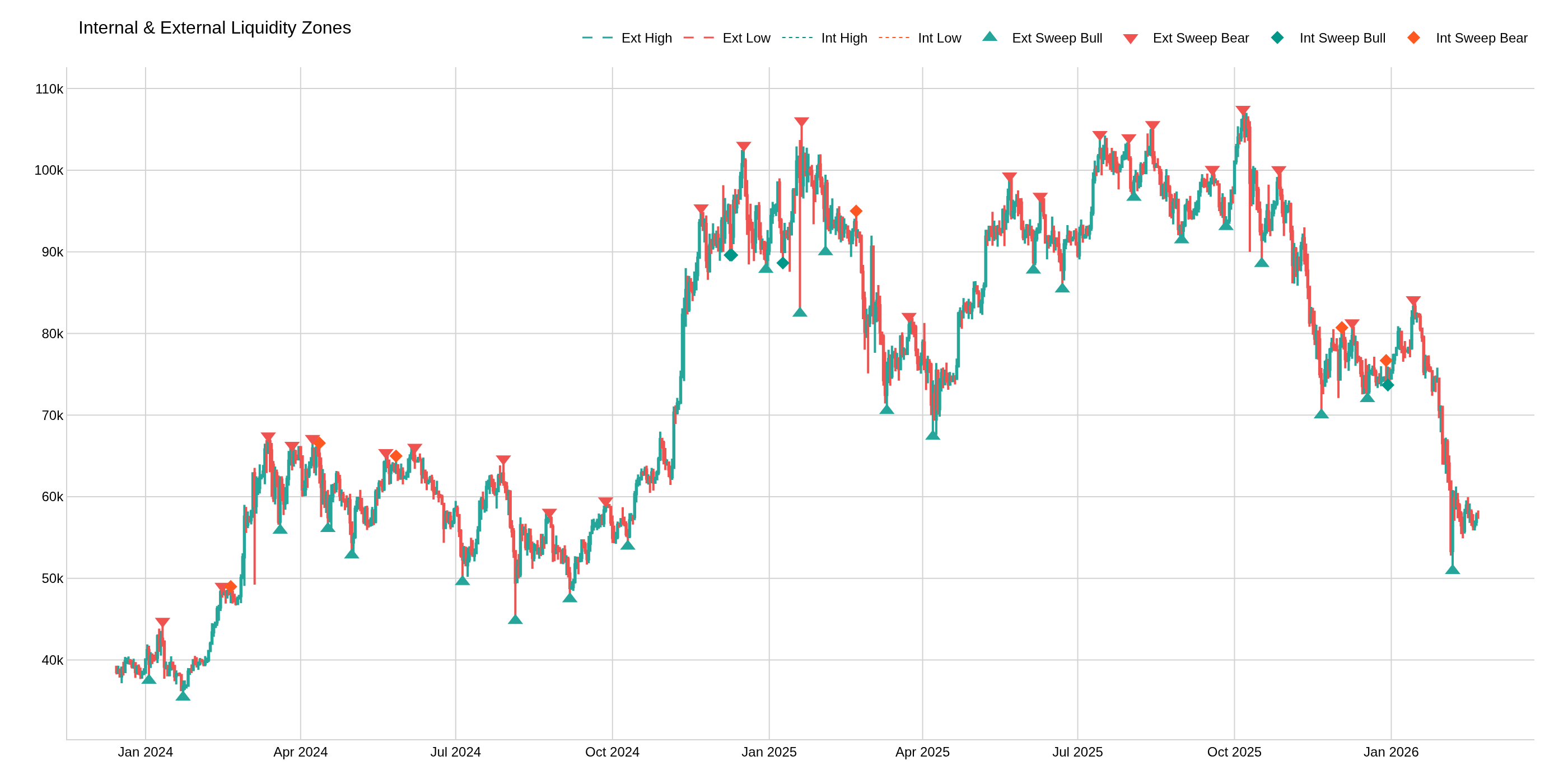
External Zones are derived from longer-period pivots (external_pivot_length) and represent major liquidity pools. Internal Zones come from shorter-period pivots (internal_pivot_length) that reside within the external range.
Core concepts:
- External Pivot — a swing high/low confirmed over a longer lookback window. These define the outer liquidity range.
- Internal Pivot — a swing high/low confirmed over a shorter lookback window. Two modes are supported:
"every_pivot"— every internal pivot creates a zone."equal_hl"— only consecutive pivots within an ATR-based tolerance create a zone (equal-high/low logic).
- Zone States — each zone transitions through: 0 = active, 1 = swept (price touched but did not close through), 2 = broken (price closed through the zone).
- Sweep Mode — determines how a zone is swept / broken:
"wick"— any wick touch marks a sweep."close"— only a close through the zone counts as a sweep."wick_close"— wick touches sweep; closes break.
- Structure (BOS / CHoCH) — for both external and internal pivots, Break of Structure and Change of Character events are detected.
Key parameters:
- internal_pivot_length — lookback/look-ahead for internal pivots (default: 3).
- external_pivot_length — lookback/look-ahead for external pivots (default: 10).
- internal_mode —
"every_pivot"or"equal_hl"(default:"equal_hl"). - eq_tolerance_atr — tolerance for the equal-high/low test as a fraction of ATR (default: 0.25).
- zone_size_atr — half-height of each zone as a fraction of ATR (default: 0.40).
- sweep_mode —
"wick","close", or"wick_close"(default:"wick"). - atr_length — period for ATR calculation (default: 14).
def internal_external_liquidity_zones(
    data: Union[PdDataFrame, PlDataFrame],
    internal_pivot_length: int = 3,
    external_pivot_length: int = 10,
    internal_mode: str = "equal_hl",
    eq_tolerance_atr: float = 0.25,
    require_internal_inside: bool = True,
    reset_internal_on_external: bool = True,
    atr_length: int = 14,
    zone_size_atr: float = 0.40,
    sweep_mode: str = "wick",
    structure_lookback_external: int = 36,
    structure_lookback_internal: int = 2,
    use_closes_for_structure: bool = True,
    high_column: str = "High",
    low_column: str = "Low",
    close_column: str = "Close",
    ...
) -> Union[PdDataFrame, PlDataFrame]:
Example
import pandas as pd
from pyindicators import (
    internal_external_liquidity_zones,
    internal_external_liquidity_zones_signal,
    get_internal_external_liquidity_zones_stats
)

# Create sample OHLC data
df = pd.DataFrame({
    'High': [...],
    'Low': [...],
    'Close': [...]
})

# Detect internal and external liquidity zones
df = internal_external_liquidity_zones(
    df,
    internal_pivot_length=3,
    external_pivot_length=10,
    internal_mode="equal_hl",
    sweep_mode="wick"
)
print(df[[
    'ielz_ext_high', 'ielz_ext_low',
    'ielz_int_high', 'ielz_int_low',
    'ielz_ext_structure', 'ielz_int_structure'
]])

# Generate a combined signal from sweep results
# 1 = bullish sweep, -1 = bearish sweep, 0 = no sweep
df = internal_external_liquidity_zones_signal(df)
signals = df[df['ielz_signal'] != 0]

# Get summary statistics
stats = get_internal_external_liquidity_zones_stats(df)
print(f"External highs: {stats['total_ext_highs']}")
print(f"External lows: {stats['total_ext_lows']}")
print(f"Internal highs: {stats['total_int_highs']}")
print(f"Internal lows: {stats['total_int_lows']}")
print(f"External sweeps: {stats['total_ext_sweeps']}")
print(f"Internal sweeps: {stats['total_int_sweeps']}")
print(f"Bullish sweep ratio: {stats['bullish_sweep_ratio']}")
The function returns:
ielz_ext_high/ielz_ext_low: 1 on bars where an external high/low zone is createdielz_ext_high_price/ielz_ext_low_price: Price level of the external pivot (NaN otherwise)ielz_int_high/ielz_int_low: 1 on bars where an internal high/low zone is createdielz_int_high_price/ielz_int_low_price: Price level of the internal pivot (NaN otherwise)ielz_range_high/ielz_range_low: Running external range boundariesielz_ext_sweep_bull/ielz_ext_sweep_bear: 1 on bars with a bullish/bearish external sweepielz_int_sweep_bull/ielz_int_sweep_bear: 1 on bars with a bullish/bearish internal sweepielz_ext_structure: Structure label at external level ("eBOS","eCHoCH", or"")ielz_int_structure: Structure label at internal level ("iBOS","iCHoCH", or"")