Liquidity Sweeps
Minimum bars needed: 2 × swing_length + 1 bars
(default params: 11 bars (swing_length=5))
Swing points need swing_length bars on each side to be confirmed. After the first swings are established, sweep signals fire in real-time.
✅ After the warmup window is filled, this indicator produces a new value on every incoming bar in real-time.
Sweep signals fire instantly when price wicks through a confirmed swing and reverses.
| Event | Lag | Detail |
|---|---|---|
| Swing high/low is confirmed | ≈ swing_length bars after the swing | Swing needs swing_length bars on each side |
| Sweep signal fires | 0 bars after the sweep | Instant: detected on the bar that wicks through and reverses |
Liquidity Sweeps is a Smart Money Concept indicator that detects when price momentarily pierces a swing high or swing low—grabbing resting liquidity—before reversing. This behaviour is a hallmark of institutional order flow: stop-loss clusters sitting above swing highs (buyside liquidity) or below swing lows (sellside liquidity) get triggered, and price quickly snaps back.
Three detection modes are available:
- Wicks – the candle wick pierces the swing level but the close remains on the original side.
- Outbreak / Retest – price closes beyond the level, then a later candle retests it from the other side while closing back.
- All – combines both wick and outbreak/retest sweeps.
def liquidity_sweeps(
    data: Union[PdDataFrame, PlDataFrame],
    swing_length: int = 5,
    mode: str = "wicks",
    high_column: str = "High",
    low_column: str = "Low",
    close_column: str = "Close",
    bullish_sweep_column: str = "liq_sweep_bullish",
    bearish_sweep_column: str = "liq_sweep_bearish",
    sweep_high_column: str = "liq_sweep_high",
    sweep_low_column: str = "liq_sweep_low",
    sweep_type_column: str = "liq_sweep_type",
) -> Union[PdDataFrame, PlDataFrame]:
Example
import pandas as pd
from pyindicators import (
    liquidity_sweeps,
    liquidity_sweep_signal,
    get_liquidity_sweep_stats
)

# Create sample OHLC data
df = pd.DataFrame({
    'High': [...],
    'Low': [...],
    'Close': [...]
})

# Detect liquidity sweeps (wick-through mode)
df = liquidity_sweeps(df, swing_length=5, mode="wicks")
print(df[['liq_sweep_bullish', 'liq_sweep_bearish', 'liq_sweep_high', 'liq_sweep_low']])

# Generate trading signals
# 1 = bullish sweep, -1 = bearish sweep, 0 = no sweep
df = liquidity_sweep_signal(df)
bullish_sweeps = df[df['liq_sweep_signal'] == 1]

# Get statistics
stats = get_liquidity_sweep_stats(df)
print(f"Total bullish sweeps: {stats['total_bullish']}")
print(f"Total bearish sweeps: {stats['total_bearish']}")
The function returns:
liq_sweep_bullish: 1 when a bullish liquidity sweep is detected (sell-side liquidity grabbed)liq_sweep_bearish: 1 when a bearish liquidity sweep is detected (buy-side liquidity grabbed)liq_sweep_high: Price level of the swept swing highliq_sweep_low: Price level of the swept swing lowliq_sweep_type: Type of sweep ("wick"or"outbreak_retest")
Trading Strategy:
- Bullish sweeps below swing lows indicate potential long entries (smart money accumulation)
- Bearish sweeps above swing highs indicate potential short entries (smart money distribution)
- Use the sweep level (
liq_sweep_high/liq_sweep_low) as a reference for stop-loss placement
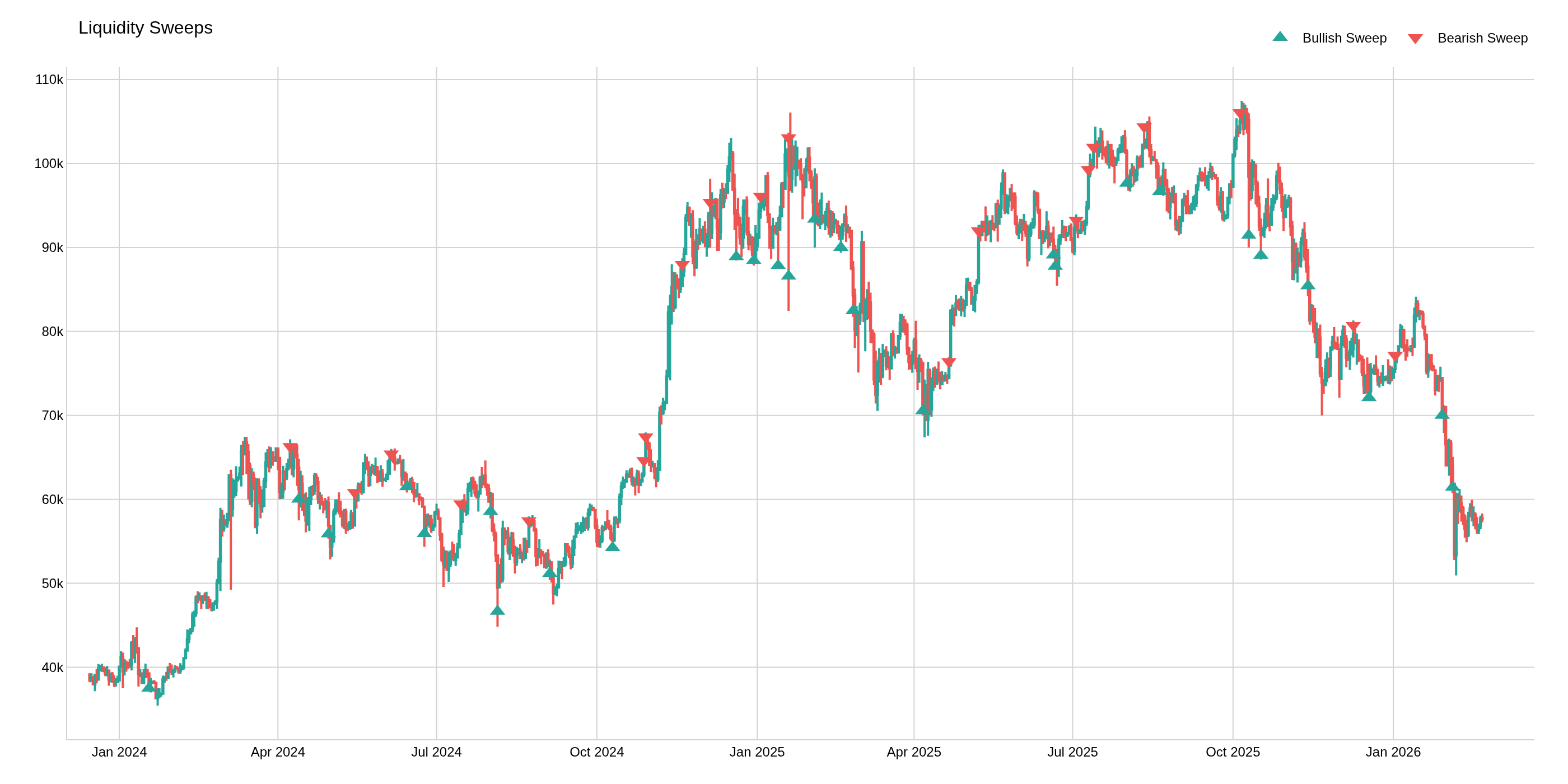
The image above uses the following parameters:
| Parameter | Value |
|---|---|
swing_length | 5 |