Rejection Blocks
Warmup Window
Minimum bars needed: 2 × swing_length + 1 bars
(default params: 11 bars (swing_length=5))
Requires confirmed swing pivots. After warmup, rejection blocks appear in real-time.
✅ After the warmup window is filled, this indicator produces a new value on every incoming bar in real-time.
Real-time Indicator
Rejection blocks appear after pivot confirmation, not after smoothing delay.
| Event | Lag | Detail |
|---|---|---|
| Rejection block zone appears | ≈ swing_length bars after the pivot | Wick-ratio candle at confirmed swing point; pivot needs swing_length bars |
| Signal fires when price returns to zone | 0 bars | Instant once the zone exists |
Rejection Blocks identify candles at swing extremes whose disproportionately long wicks signal institutional rejection of a price level, creating a tradeable zone.
Concept (ICT / Smart Money):
- A Rejection Block forms when a candle at a pivot point has a wick that is at least
wick_threshold(default 50 %) of the total candle range. - The long wick shows that price was driven to a level but was rejected — institutional participants absorbed the orders and pushed price back.
- Bullish Rejection Block: At a confirmed swing low, the candle's lower wick (Low → body bottom) is disproportionately large. The zone spans the lower wick area.
- Bearish Rejection Block: At a confirmed swing high, the candle's upper wick (body top → High) is disproportionately large. The zone spans the upper wick area.
- When price returns to this wick zone, the same institutional interest is expected — a potential trade entry.
Signals:
- Entry Long: Price retraces into the bullish RB zone (potential long entry)
- Entry Short: Price retraces into the bearish RB zone (potential short entry)
- Mitigated: Price closes through the opposite side of the zone (block invalidated)
def rejection_blocks(
    data: Union[PdDataFrame, PlDataFrame],
    swing_length: int = 5,
    wick_threshold: float = 0.5,
    high_column: str = "High",
    low_column: str = "Low",
    open_column: str = "Open",
    close_column: str = "Close",
) -> Union[PdDataFrame, PlDataFrame]:
Returns the following columns:
rb_bullish/rb_bearish: 1 when a Rejection Block is establishedrb_top/rb_bottom: Active RB zone boundaries (forward-filled)rb_direction: 1 for bullish RB, -1 for bearish RB, 0 when no RB is activerb_entry_long/rb_entry_short: 1 when price enters the RB zonerb_mitigated: 1 when the RB zone is mitigated
Signal function:
rb_signal:1= long entry,-1= short entry,0= no signal
Example
from investing_algorithm_framework import download

from pyindicators import (
    rejection_blocks,
    rejection_blocks_signal,
    get_rejection_blocks_stats,
)

pd_df = download(
    symbol="btc/eur",
    market="bitvavo",
    time_frame="4h",
    start_date="2024-01-01",
    end_date="2024-06-01",
    pandas=True,
)

# Detect Rejection Blocks
pd_df = rejection_blocks(pd_df, swing_length=5, wick_threshold=0.5)
pd_df = rejection_blocks_signal(pd_df)

# Get summary statistics
stats = get_rejection_blocks_stats(pd_df)
print(stats)

pd_df[["Close", "rb_bullish", "rb_bearish", "rb_top",
       "rb_bottom", "rb_entry_long", "rb_entry_short",
       "rb_signal"]].tail(10)
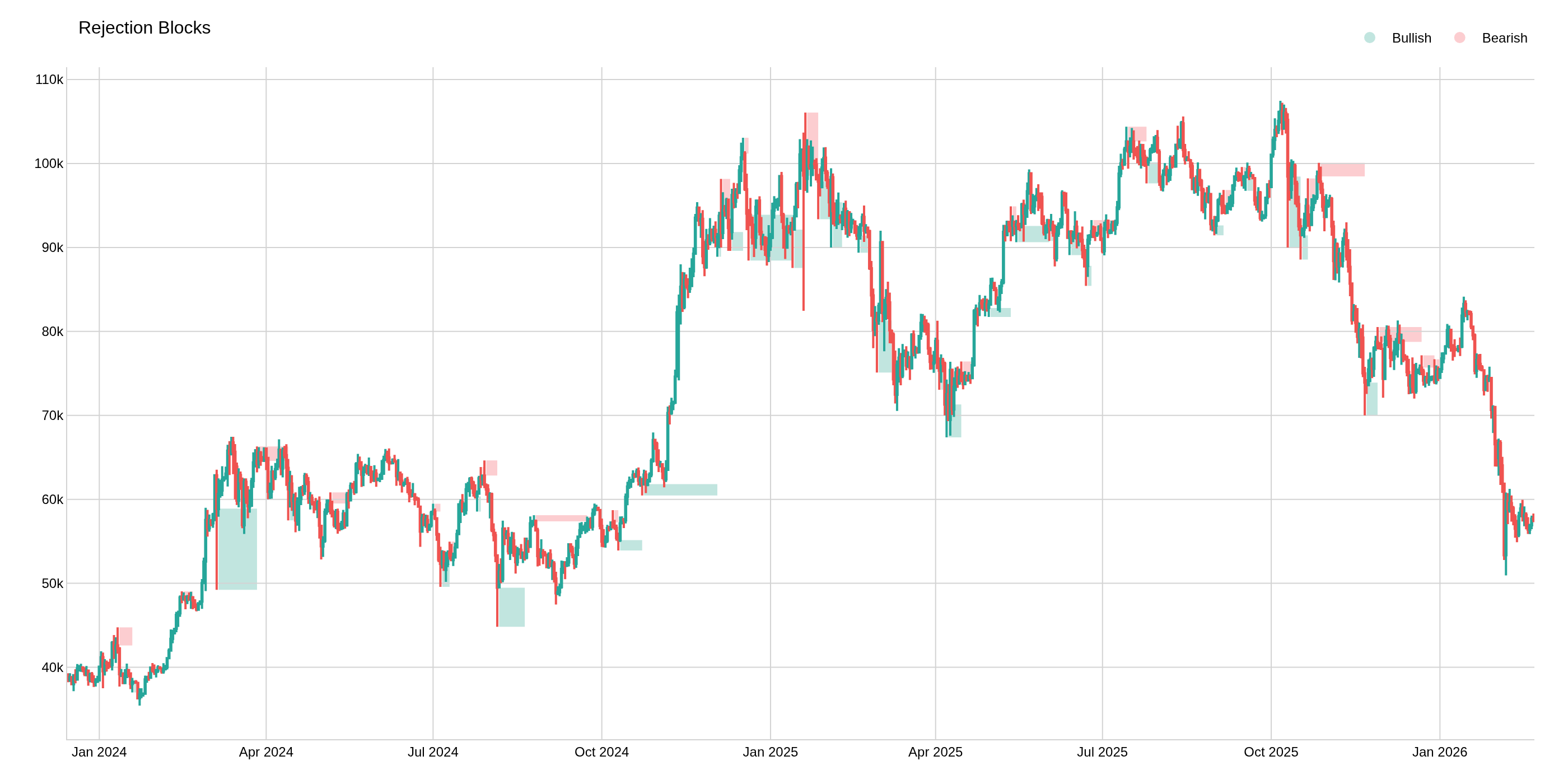
Chart Parameters
The image above uses the following parameters:
| Parameter | Value |
|---|---|
swing_length | 5 |